Part two of a five-week series on modern GTM storytelling. A new chapter drops each week.
Destruction is interesting.
It takes a skilled luthier hours to build a beautiful instrument, and seconds for a guitarist to smash it over an amp on stage.
In Same as Ever (2024), Morgan Housel explores this pattern as it shows up over and over again across the physical world. He argues that progress has dependencies, which means that building something meaningful requires getting many things to work reasonably well in succession over time while accounting for and pushing back on the pressures from any number of external forces during the process. But one failed dependency can wipe out everything else.
Destruction doesn't play by those rules. You don't have to systematically reverse every step that created something to destroy it. Destruction is faster, and usually unexpected or unintentional — except for the guy smashing the guitar, or the people torching an elaborately crafted wooden effigy in the desert.

Pressure works the same way as dependencies. You know the overused line about turning coal into a diamond? I hate making such broad comparisons to completely unrelated things, but in this case the analogy holds up.
Pressure pushes against progress nearly all of the time, and that's also true of progressing and winning a deal in B2B SaaS (LinkedIn post idea, for anyone who wants to use it). Usually that's a good thing: pressure is what turns the coal into the diamond. Similarly, pressure is what also acts as a forcing function for you to continuously build and refine something that actually solves a problem someone will give you money to solve.
The Pressure it Takes to Destroy A Deal
Picture a deal that's been humming along nicely. The buyer loved the demo, the pilot went clean, and everyone on your side has the quiet confidence that usually precedes a signature.
Then, with the ink almost dry, someone on the buyer's side finally runs the due diligence everyone assumed had already happened — and pulls the vendor's security history.
Ruh roh. There was a breach, years back, and long since resolved. So who cares, right? Nothing about the pitch changed. Nothing about the product changed. But the whole evaluation stops cold that afternoon, because a fact that had been sitting there the entire time finally reached the one person whose job is to care about it.
The rep didn't screw this up. Everything said up to that point may have been true, persuasive, even airtight. It just wasn't the argument that mattered to the person holding veto power. And now you have to take more time and energy to respond to this objection, and even if you do, the fact that the breach even happened could be the non-starter that ends the deal anyway, no matter how well it was handled.
We’ve named the six decision pressures behind moments like this — outcome, adoption, technical fit, risk and governance, financial, and internal credibility. Every deal carries all six to some extent, whether or not your side ever calls them by name.
If your sales people lose a deal, it's because of one or more of these. The good news is you have control over how you build strategy, content, and enablement to prepare everyone to progress through the pressure.
This chapter covers how and when each pressure calls the shots, and provides guidelines to their relative weight, and how to speak to them.
Outcome pressure
You'll recognize this one when the buyer starts narrating your pitch back to their own success metrics before you've even finished the pitch — "so this would move X," "that closes the gap we flagged on Y." They're already composing the memo they'll send upstairs. Whenever someone steers the conversation toward what they get to report rather than what the tool actually does, that's outcome pressure doing the talking.
The pressure is on the ability to describe how the functionality of the product translated to the value it drives, connected to an outcome that matters to the business. You know this from product marketing 101. What's good to keep in mind is that pressure exists on the buyer side to explain how your product connects to the outcome, but there is also dimensionality in how you do this.
Also, when spending tens or hundreds of thousands of dollars, humans generally like to see proof that something works before they buy it.
Adoption pressure
This pressure almost never announces itself as an objection. It shows up sideways, as a question about somebody else entirely — something like "will my team actually stick with this," "how many logins are we up to now," "what happens once the new-tool honeymoon period wears off." Nobody's worried about the demo going well. They're worried about six weeks from now, when the old habit is still sitting right there, still easier, still free.
One of my favorite product-specific adages comes from Cory Doctorow: "The most important fact about a given technology isn't "what it does", but "who it does it for" and "who it does it to".
The meaning of "who it does it for" is obvious, but "who it does it to" is conveniently ignored — usually by sales people or your execs and board members who care more about quota attainment and short term success than long-term value for the customer. The question to answer is “Who becomes a victim or beneficiary of the use of this technology?” What I mean by this is who either benefits, or suffers the opposite, from the use of this technology. Understanding this, either through precedent or theory, is helpful in responding to adoption pressure.
Knowing this is an important part of being able to articulate the vision and story of how your technology will be adopted into the organization into which you're selling it. Going back to the intro of this book, assuming you're a more system-minded employee, your intention is to market and sell a product that will be adopted, used, valued, and ultimately retained by the customer.
My favorite framework for true product-market fit comes from Anthony Pierri and Robert Kaminski of Fletch PMM. They describe product market-fit multidimensionally as "PMF is when you can repeatably find, sell, serve, and retain customers on the same use case". If your company can't serve your customers by helping them actually use the product and reach value on the same use case you used to originally sell them on the product, you will eventually lose them. This is a good practice for most people who care about being at a company for more than say, 10 months.
Technical fit pressure
Does your product fit in with everything else? Does it make workflows simpler or more complicated? What can be done in your solution vs outside of your product? Do users need to directly interact with your product at all?
Underneath the procedural-sounding questions — "how does this talk to our CRM," "what's implementation actually going to take," "who's on the hook for this integration once it's live" — is a person in the buying committee trying to price out how much operational drag they're about to inherit, long after your team has moved on to the next deal. None of it resolves to a clean yes or no, but instead resolves to a workload somebody else has to absorb — another example of keeping in mind “who your product does it to” from the previous section.
Risk and governance pressure
You’ve probably heard some C-level or legal person talk about this. At most companies where I’ve worked, some exec has stood up during an all-hands to proudly announce “We’re now SOC 2 compliant!” or something like that. The 15% of employees in the crowd who recognize what this means — that is, the company has unlocked the ability to close more deals because they can meet certain buyer requirements — cheers, whoops, and hollers while the remaining 85% of the crowd either don’t understand or care. If you’ve found yourself as one of the 85%, I would suggest you make yourself part of the 15%, because understanding the risk and governance pressure is incredibly important.
Of the six pressures, this is the one that seems to stay quiet the longest. For most of the deal it looks like paperwork — a questionnaire here, a document request there, nothing anyone seems worried about. Then, late, without warning, it can bring the whole thing to a dead stop. All because something that was true the entire time — where the data actually sits, who can reach it, what the failure mode looks like — finally landed on the desk of someone whose entire job is saying no to exactly that.
This pressure is a gatekeeper, not an economic driver. It usually doesn’t get a deal excited, but it can end one. Plan for the moment it enters play, because it eventually will.
Financial pressure
Financial pressure comes in the form of someone running arithmetic and asking questions like "is this year's budget or next year's," "what gets cut to make room for this," "can you give me a number that survives a room you won't be in." It's almost never a question of whether the price is fair. This is more a question of whether that number holds up once your rep isn't there in the room to defend it.
Good people and businesses generally don’t hoard their money. They want to spend it on people who are likable and offer value. What I’ve experienced is that if you have a good enough offering, tell a good enough story, and offer good enough proof points that the thing you sell actually works, there are people who have budget to give you a chance. Determining what is “good enough” is largely your job as the researcher and storyteller.
Internal credibility pressure
The people you’re selling to care more about their own careers and reputations than they care about yours. But they probably won’t say it that explicitly.
For that reason, this pressure is highly empathy-based, and it takes genuine concern for the feelings of the people on the other side. This is the foundational idea behind the “hero” when people talk about the hero section of a homepage. Hero is borrowed from ancient storytelling basics, and in the traditional sense, most stories have one key hero. We like to think of ourselves as the heroes of our own stories, and the same goes for the people you want to buy your stuff.
The reality in which we live doesn’t have clear heroes and villains. Most stories that represent reality don’t have single hero as much as they have multiple heroes (and villains) who all exist and behave in shades of grey.
Such is the case of managing the stories you tell to a buying committee. Everyone wants to be the hero of their own story — even if they actually exist in some gray area. Handling the pressure of internal credibility means making everyone look like a hero — the power user and the pencil-pushing procurement and finance person, alike. We are all more alike than we are different. We want to look good, and we need to determine how the people on the other side of our deal define good and how to make them look that way to others.
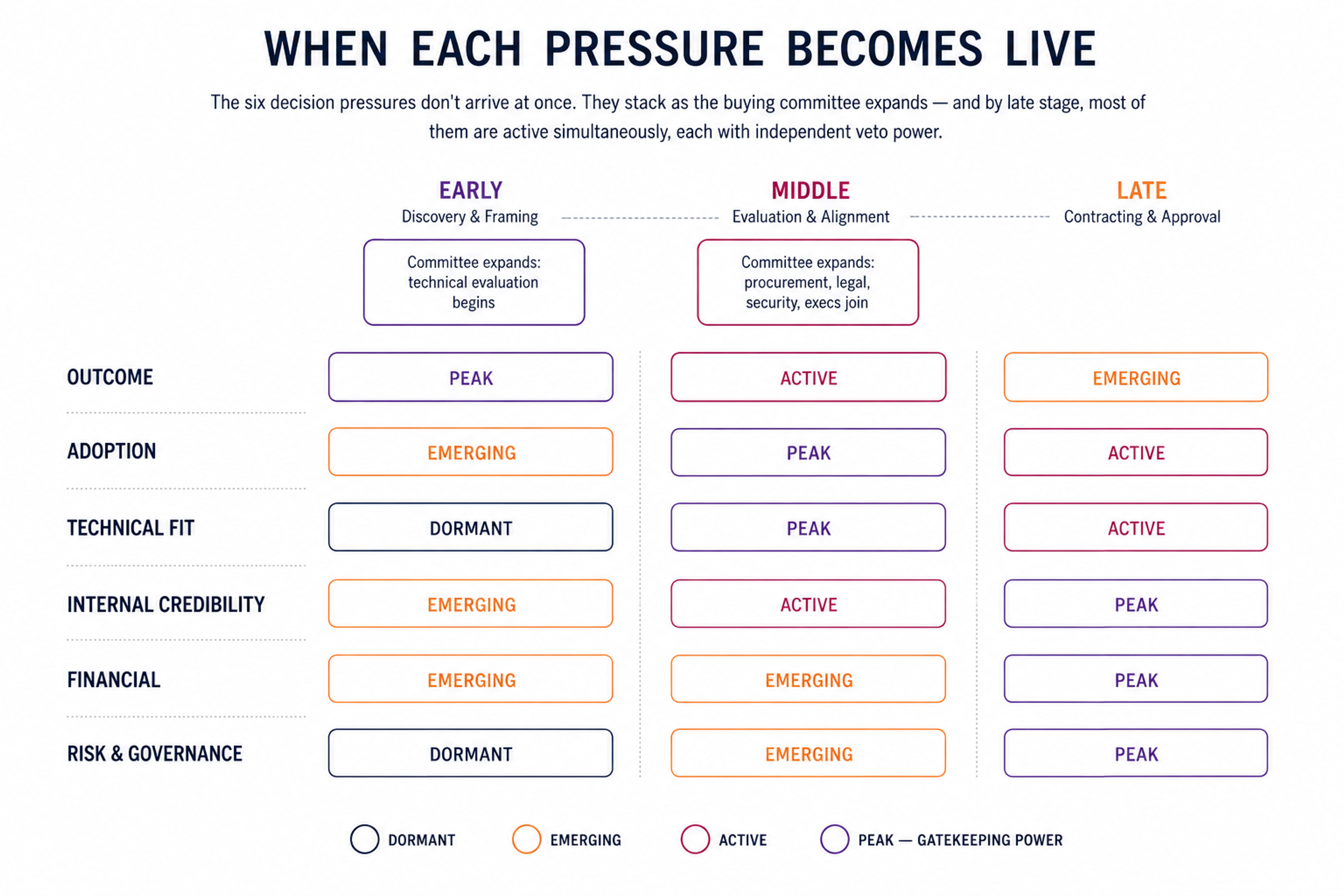
The Pressure Activates at Different Points in the Cycle
The storytelling speaking to the pressure doesn’t happen all at once. Sales cycles can be long, and as new stakeholders enter, the messaging shifts slightly to speak to what each of the new stakeholders value.
Be Prepared for the Pressure to Change Mid-flight
Scar knew to be prepared when he sang to his hyenas in the second-best Disney villain song ever written (Poor Unfortunate Souls from Ursula takes the top spot).
The dominant pressure on a deal isn't fixed. It shifts — often for reasons that have nothing to do with your product. You can't diagnose and solve for it once, call it good, and move on.
Take for example a couple similar situations. Maybe a reorg lands, and a deal that was moving on outcome pressure suddenly has a new owner who wasn't on any of your calls and doesn't share the old owner's urgency. Or a situation when a new Sr. VP arrives, inherits a decision they didn't make, and insists on wasting a bunch of time re-litigating it from scratch because they need to be the hero (or establish dominance by reminding everyone who the boss really is).
Preparing to Resolve the Pressure Without Guessing
When it comes to preparing to respond to the pressure, the conventional wisdom is usually some vague variation of "read the room," or building a makeshift AI agent to pull bland pre-call insights on what might speak to the pressure. For a few reps in the right place at the right time, that works. For everyone else, it's hard to say how to do this without it just becoming another word for intuition.
Three things may help.
Notice what a stakeholder's language is optimizing toward, not just what they're asking about. Two people can ask "will this integrate with our CRM" for different reasons — one checking technical fit, the other trying to assess risk. The words are identical, but the pressure behind them isn't.
Read a late, out-of-nowhere objection as a timing signal. Governance concerns in week one are normal diligence. The same concerns in week nine, right before signature, over a fact that was true the whole time, usually mean the pressure was there all along and just hadn't reached the right person yet.
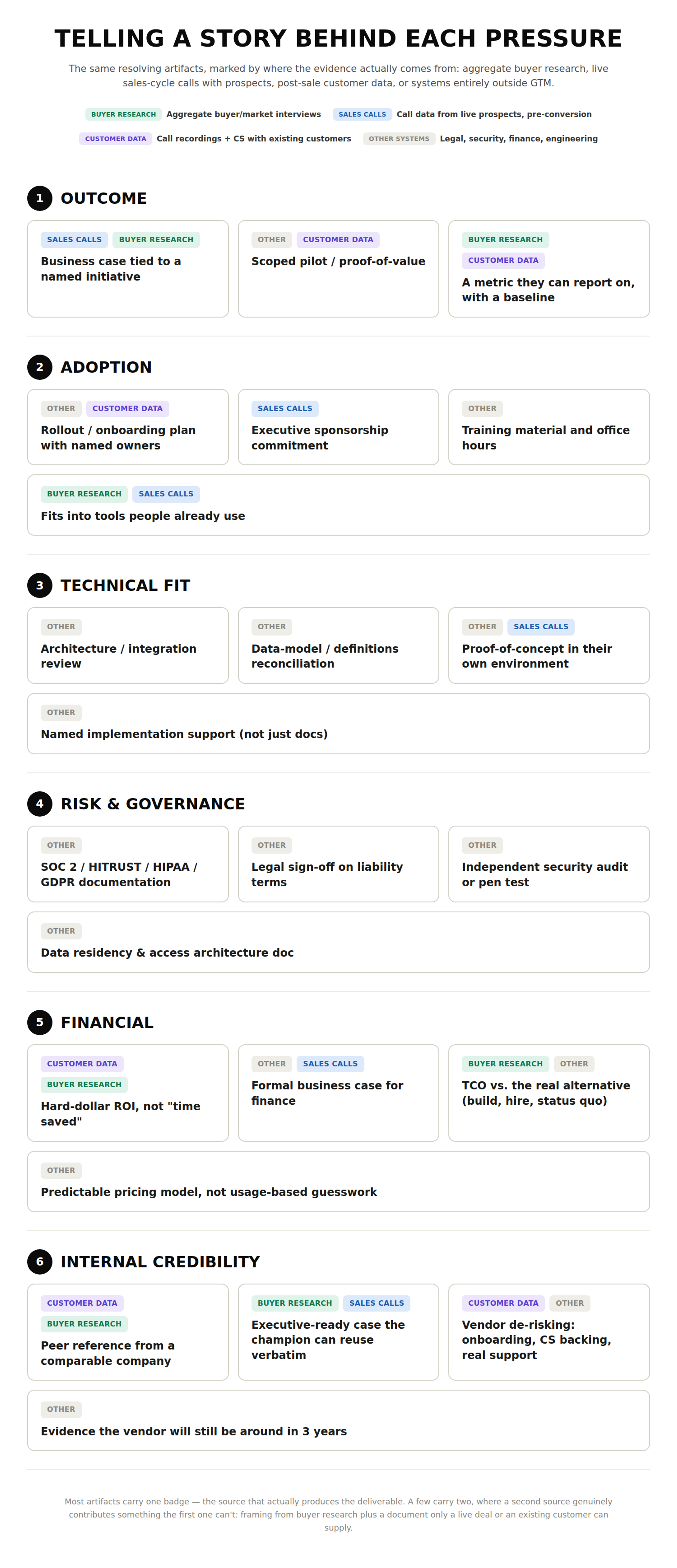
Check whether a stated reason resolves specifically or stays vague — and know ahead of time what "specific" looks like, because it's different for each pressure. Outcome pressure resolves with a business case tied to a named initiative, not a compelling pitch. Adoption pressure needs a rollout plan with a real executive sponsor behind it. Technical fit might need a proof-of-concept run in the buyer's own environment. Risk and governance needs an independent audit or a legal sign-off — never your word for it. Financial pressure needs a number finance will still defend after your rep has left the room. Internal credibility is a little more complicated, but typically needs a reference and a good story the champion can hand straight to their own person making the final buying decision.
If what you get back instead is some version of "we'll circle back", with no document, no name attached, and no date — that's the clearest sign the stated pressure isn't the real one yet.
Some of these artifacts you can build straight from real language pulled from market research or customer call data: a peer reference, a case built around what already resonated with a comparable company, an executive-ready summary a champion can reuse word for word. Others, like a SOC 2 report, an integration review, or a legal sign-off, come from teams that have nothing to do with marketing, and no amount of research produces them.
That split is exactly what the chart below maps out: which resolving artifacts you can actually go build yourself, where the best data to inform it comes from, and which ones you're better off flagging early to whoever owns them, instead of promising a document that isn't yours to produce.
These Pressures Aren't Owned by Single People
One thing worth making explicit before this framework gets used in the wild: risk and governance pressure doesn't live in one seat. It's usually split across at least three different people who rarely agree with each other on the same timeline: security (can we trust the architecture?), legal (can we accept these terms?), and procurement (does this vendor clear our process?). Treating one pressure as one archetype's problem, which is what you’re implicitly asked to do with several sales methodologies, means you prepare for one conversation but get blindsided by two others that were never on the radar.
TL;DR — Chapter 2
- Every deal carries six decision pressures — outcome, adoption, technical fit, risk and governance, financial, internal credibility — whether or not you name them.
- A deal can die late over a fact that was true the whole time, because it finally reached the person who cared about it, not because anything about the product changed.
- The dominant pressure shifts mid-deal for reasons that have nothing to do with your product — a reorg or new VP can flip it overnight.
- To read pressure without guessing: notice what language is optimizing toward, treat late objections as a timing signal, and check whether a stated reason resolves specifically or stays vague.
- Some resolving artifacts come from market or customer research; others (SOC 2, legal sign-off) come from teams outside marketing entirely.
- Risk and governance isn't one person's job. It's split across security, legal, and procurement, each on its own clock.