Part four of a five-week series on modern GTM storytelling. A new chapter drops each week.
Most B2B teams still believe a cute myth:
“Give buyers enough evidence, and the best product wins.”
It's a comforting idea, because it makes every loss feel fixable. Just add one more case study. Tighten the deck. Publish the benchmarks. Surely, once the market sees enough of the facts clearly, the better offer will win out.
But in complex buying, that’s rarely how decisions feel from the inside.
Buyers don't sit in a quiet room, weigh the evidence like scientists, and crown the best product. They take a pile of scattered signals: a brand name, a peer's offhand comment, how the demo went, a promise about support, the pricing structure, how hard implementation looks, whether the executives feel comfortable. Then they turn all of that into one story about what's safe to do next. The deal usually goes to whoever told the safest, most believable story.
It's the meaning buyers attach to a signal, not the raw signal itself, that wins the deal.
This isn't true of every purchase. For simpler, more commoditized products, buyers really do just compare price, features, and terms. But complex B2B deals are different: the risk of a bad implementation is legit, a lot of people are involved, and getting it wrong costs more than money. It costs the company, and it costs the people who signed off on it. In that world, buyers aren't just choosing a product. They're choosing what that product will end up meaning for the company, for their team, and for their own reputation.
What these companies are buying is a future they believe they can survive.
Buyers don’t buy products; they buy safety
A safety story is simply the explanation a buying group tells itself for why this choice makes sense, why it'll be supportable, and why it won't turn into something that gets you fired.
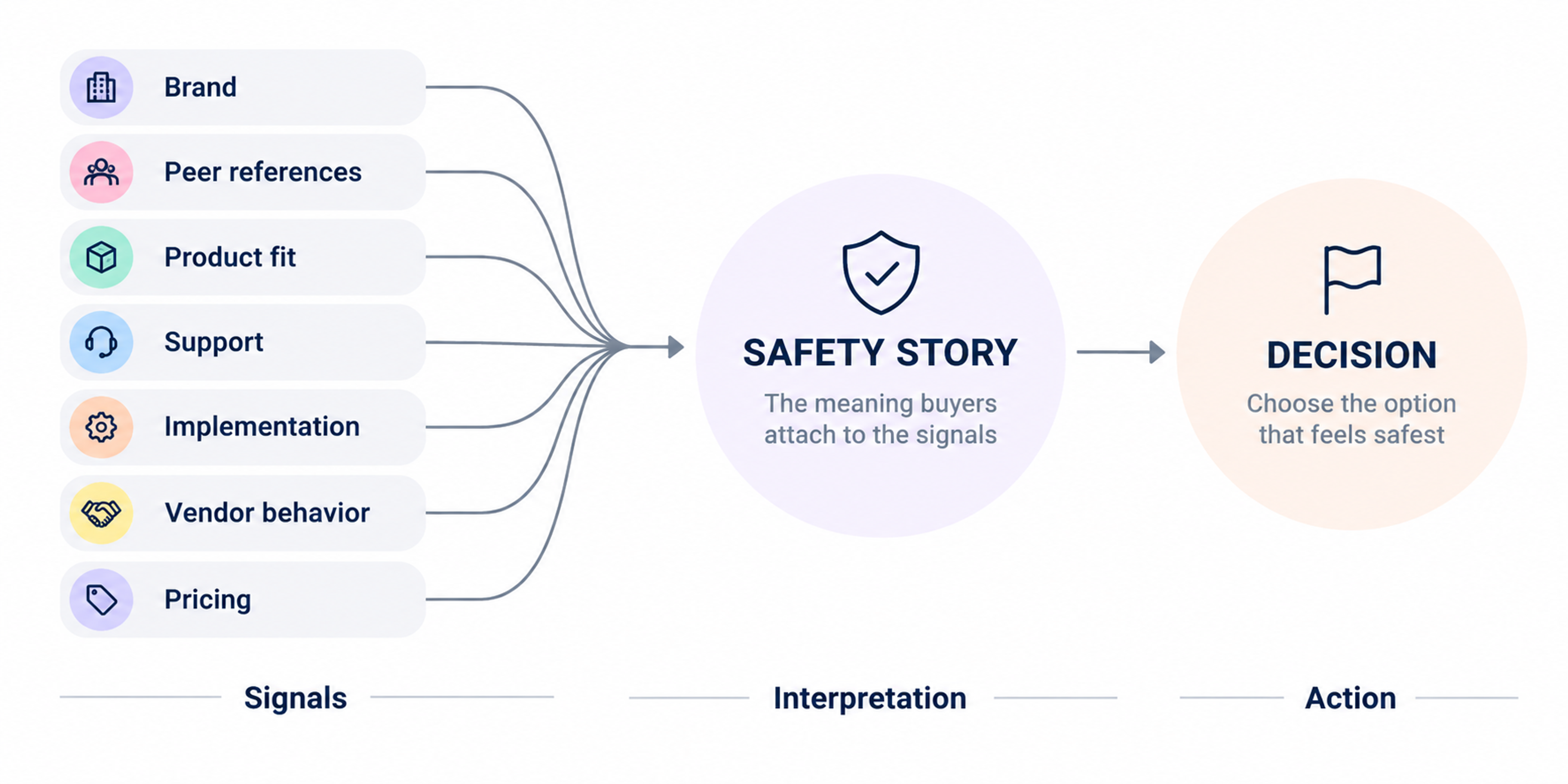
That story usually includes the product itself, but the product is only one ingredient. Buyers also want to know whether the vendor will stick around, whether support will show up when needed, whether the rollout will be manageable, whether other respectable companies made the same call, whether their own team can defend the purchase later, and whether anyone will regret it six months down the road.
This is what a lot of GTM teams miss. They assume proof speaks for itself, like more evidence automatically adds up to more conviction. But buyers aren't collecting proof for its own sake. They're using it to answer a much more personal, much more political question: What exactly am I being asked to believe here, and how bad would it be for me personally if I'm wrong?
The pattern in our research is remarkably consistent. Buyers kept leaning toward whichever option felt more practical, more proven, more supportable, or easier to explain to the people above them, even when a competing option had genuine fans inside the building, or looked stronger on some narrow technical point.
Again and again, the winning vendor wasn't the one with the best product argument, but the one that told the least alarming story.
The practical option beats the preferred one.
I told a version of this story earlier in the book: the contract-management deal where the people who'd use the software day to day preferred the smaller challenger, but the CIO picked the bigger, more established platform anyway. It's worth a second look here, because chapter one looked at that story through the lens of survival, and this chapter looks at the same event through the lens of safety.
The senior stakeholders were judging something else entirely: whether the choice could be supported, defended, and easily justified to the people above them, and easily answered for later if someone asked, casually or not, “why did we go with them?” That's why “best product wins” is such a misleading phrase in enterprise sales. Best for who, on which measure, under whose unwritten political rules? That buying group was really solving a problem of personal exposure, not settling a product contest, and the product contest was just what it looked like from the outside.
Buyers trust whatever lets them rehearse the regret in advance
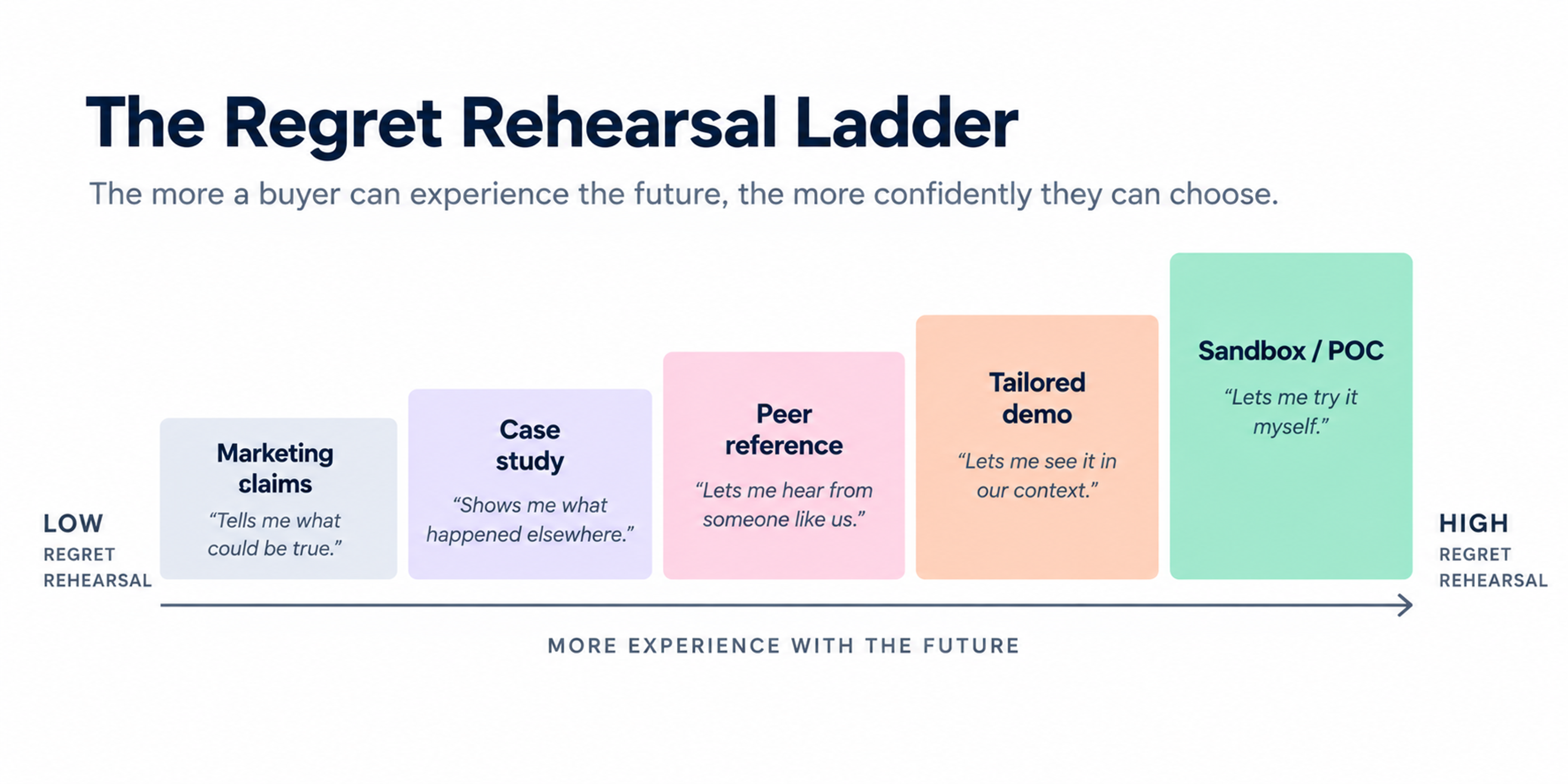
To “rehearse the regret” means to test out, ahead of time, what it would actually feel like if this choice goes badly, instead of just taking someone's word for it. That's what buyers are really doing every time they ask for a sandbox, call a reference, or run a pilot: playing out the worst case before they're the one who has to live with it.
If safety stories were built only out of brand familiarity, smaller or newer vendors would never win a deal. But they do win, plenty of times. They win when buyers find some way to test whether the reassuring story holds up.
That's the real reason peers, consultants, and hands-on trials carry so much weight. Every single time, buyers trust whatever lets them see what actually works, what breaks under pressure, and what day-to-day life with the product will really feel like, more than they trust a polished slide deck or generic marketing copy.
Across our research, sandbox access, proofs of concept, tailored demos, and honest peer references keep showing up as the exact moments where trust gets built. And it's not because buyers want more content to read. It's because they're looking for better ways to reduce their own uncertainty before they have to personally own the outcome.
Take the buyer who trusts a sandbox more than a pitch deck. On the surface that seems obvious: of course seeing the product helps. But the actual reason runs deeper. A sandbox is valuable not because it gives the seller more claims to make, but because it lets the buyer turn claims into lived experience. They can see for themselves whether the tool holds up under real use, whether it fits how their team actually works, whether the workflow feels clunky, whether the data does something weird, and/or whether the promise survives contact with reality.
The same logic applies to peers and consultants. A peer isn't persuasive because their opinion carries some magical extra weight. A peer is persuasive because they already took on some of the risk themselves. They can say, in effect, “We tried it. Here's what happened. Here's where it held up. Here's where it didn't.” That's far more useful than a vendor telling you everything is wonderful.
In other words, buyers trust the sources that help them rehearse regret before they commit.
Brand is compressed risk information wearing a familiar logo
Executives like to talk about brand as if it's shallow, a cosmetic layer sitting on top of the real substance. But that's not how buyers experience it.
In complex B2B buying, brand acts like compressed risk information. A list of recognizable customers, a reputable logo, and signs that a vendor is built to last all create comfort, and not just because they're familiar. They signal that the company can support the product, survive the length of the contract, and hold up under scrutiny.
Some buyers — deep down inside — also really just want to be using the same stuff as their cooler peers out there.
This is frustrating if you're selling against an incumbent or a category giant. It can feel completely irrational. Why should some other customer's logo matter this much? Why should “big vendor energy” beat out real, specific advantages?
Because the logo doubles as evidence.
If companies that look like theirs already bought the product, the internal story writes itself: people like us already trusted this vendor. And if the vendor is big and established, the buyer gets to tell a calmer story about things like continuity, ongoing support, and less downside risk.
If the vendor has real scale, procurement and IT can both picture fewer ugly surprises down the road. None of this means brand always beats substance, just that it shifts who has to prove what.
A known vendor starts the race already wearing the safer interpretation. An unknown vendor has to earn that same interpretation, inch by inch, starting from zero.
Support is a significant part of the buy
After looking through all our data around how buyers talk about risk, and interesting pattern shows up: they almost never keep the decision narrowly about feature fit. They want the vendor to take real organizational risk off their plate, not just describe some functional benefit on a slide. That means onboarding, training, support quality, financial stability, and sometimes even creative contract terms that lower the buyer's exposure while their team gets up to speed.
That's one reason “we have the better feature set” so often fails as a winning argument on its own. Buyers are evaluating the whole package of what it takes to adopt the product. They're asking whether the vendor will help carry the burden of change.
Picture two vendors with roughly the same capability. One insists the product is intuitive, implementation will be fine, and the standard terms are just standard terms. The other admits there's real work ahead, lays out a structured onboarding plan, offers training, spells out support coverage clearly, and stays flexible about how the customer gets started. Which one feels safer?
Not necessarily better on paper, but safer in life.
That difference matters because buyers don't experience implementation as just a technical event. They experience it as a stress test that runs across the whole organization. A vendor that lowers that stress is doing more than making onboarding smoother. It's making the whole safety story stronger.
How the vendor's people behave changes what the product means
Trust isn’t built by assets alone. Trust is human, and thus it is built on interaction.
Buyers notice whether a vendor's team acts like a partner or just puts on a performance. They notice whether the vendor admits its shortcomings, whether the demo is tailored to their real use case, whether the answers feel honest, and whether the conversation feels like solving a problem together instead of just being sold to.
This matters more than even many seasoned sales teams realize. Research aside, I’ve seen this play out countless times over the past 15 years.
A vendor can have great functionality and still hurt its own chances by coming across as evasive, over-rehearsed, or indifferent to the customer's actual situation. The product itself might be good. But the story buyers start telling themselves gets dangerous fast: if they're this slippery now, what's support going to be like later? Or: if they can't even tailor a demo to our setup, is implementation going to be just as generic?
Consider the Van Halen brown M&M story, but applied to a sales context. If you're not familiar, you can search in whatever tech oligarchs platform you’ve pledged allegiance to.
The conclusion made by the band was: If these people working for the venue can’t event follow simple instructions on a rider, can I trust them to make sure the venue’s PA doesn’t electrocute anyone on stage?
Whether David Lee Roth occasionally needed to be electrocuted is debatable.
On the flip side, when the vendor's people are candid, adaptable, and clearly invested in the buyer succeeding, they build a different story instead: these people will help us through whatever comes up.
That's why custom demos and proofs of concept matter so much. They do more than show off what the product can do. They reveal how the vendor actually thinks, how honestly they deal with constraints, and whether they can turn theory into something that works in the buyer's real world.
A tailored demo says, “We understand your world.” A transparent answer says, “You will not have to discover the hard parts alone.” A thoughtful trial says, “What we claim can survive contact with your use case.”
These are key mechanisms of trust more than presentation tactics, and trust is what wins deals and ongoing relationships that are mutually beneficial to everyone.
Incumbency shapes interpretation before the evaluation even begins
One of the hardest truths in B2B buying is that many evaluations are not neutral from the start.
Existing relationships, incumbent vendors, channel partners, and familiar ecosystems usually start the race a step ahead, before any formal comparison even begins. Buyers naturally lean toward what they already use, what plugs into their existing stack, what procurement already knows how to buy, or what support teams already understand, because all of that makes the pricing, the explaining, and the internal coordination simpler.
In our interviews, familiarity reliably lowers friction and raises comfort well before anyone has dug into what the product does. That tells you something specific: incumbents don't just carry a commercial head start into a competitive deal. They carry a head start in the story, too. Their option already feels safer, simply because the organization has fewer unknowns left to deal with around it.
This is why challengers keep getting blindsided by losses after evaluations that felt strong the whole way through. They thought they were competing against a product when they were really competing against was a safety story that already had a head start: easier to support, easier to bundle in, easier to explain up the chain, easier to get approved without a fight.
And unless the challenger can hand the buyer a truly better story, not just a better feature list, that head start usually just holds all the way to the signature.
When features and price really do decide
It would be a mistake to throw out one more grand theory that explains everything and leaves no room for exceptions.
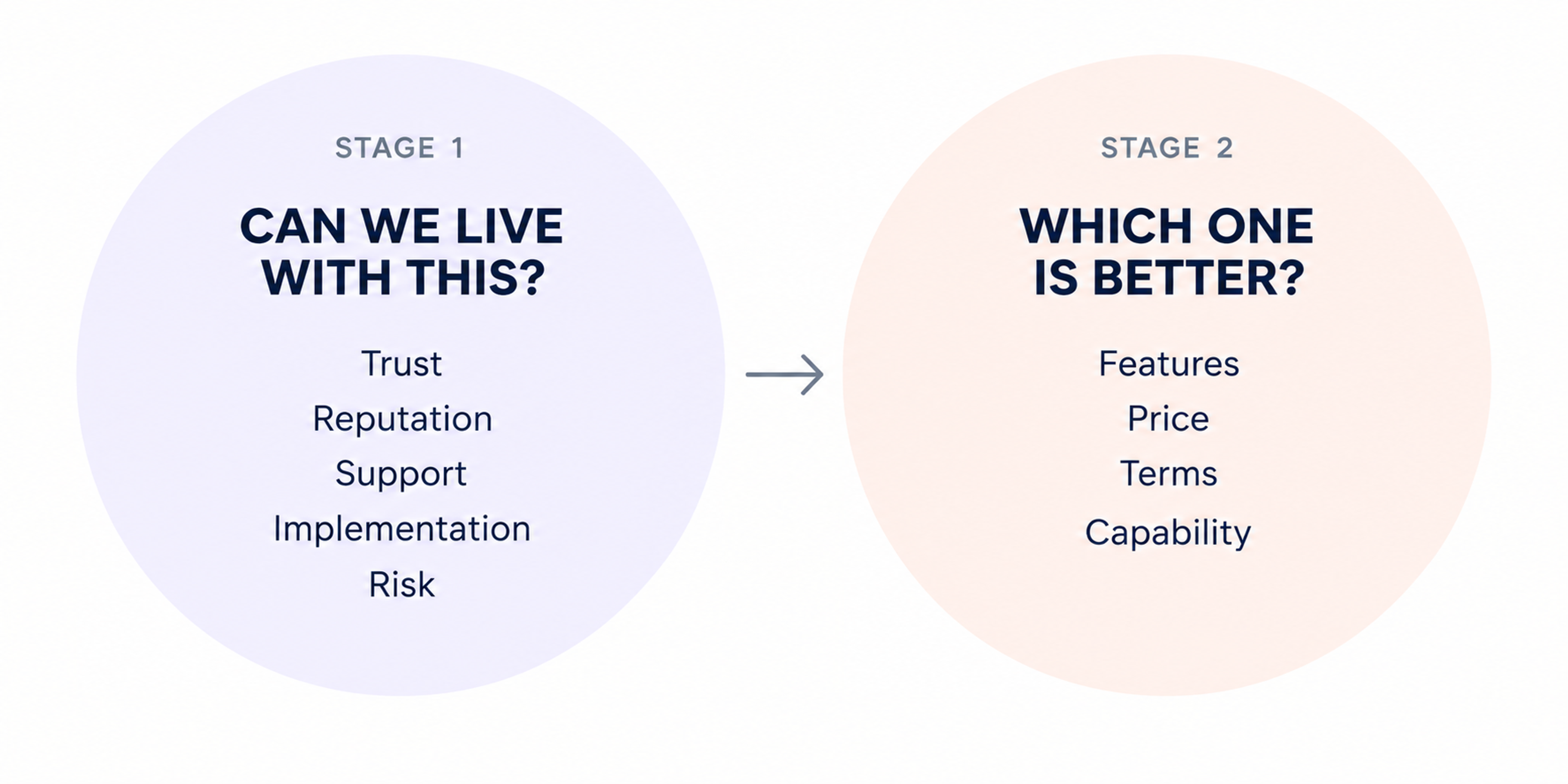
So here's the exception, straight from the buyers themselves: when two options are genuinely equal on reputation and reliability, some decisions really do just come down to features or price. That exception is worth pointing out, because it sharpens the main point instead of undercutting it.
Features and price don't disappear from complex B2B buying. They just tend to decide things later, only after some baseline level of trust and safety has already been cleared. If two vendors are both believable, both supportable, both reputable enough, and both unlikely to create avoidable chaos down the road, then yes, specific features, commercial terms, or total cost really can become the deciding factor.
The mistake most GTM teams make is behaving as though buyers start their evaluation there. In complex B2B deals, they usually don't.
Usually buyers only get to that comparison after they've already narrowed the field down to the handful of options they believe they could live with. That's why a product can be superior and still lose commercially. Better doesn't automatically mean safer. Cheaper doesn't automatically mean easier to defend in a budget meeting. More features don't automatically add up to more trust.
What most GTM teams misunderstand about “more proof”
The instinctive response to all this is to ask for more proof.
More customer stories. More ROI content. More one-pagers. More comparisons. More demos.
Some of that helps. But only if it helps the buyer believe something that matters.
This is the misunderstanding sitting at the center of a lot of go-to-market systems: teams confuse how much evidence they have with how useful that evidence actually is. They assume proof is persuasive just by existing. In reality, proof only matters because of what it lets the buyer conclude.
Can I trust this vendor?
Will they support us when things get messy?
Will my peers think this is a sensible choice?
Will procurement, IT, and leadership see this as responsible?
Will this fit our use case, not just the vendor’s script?
If this goes badly, will I look reckless for having chosen it?
In complex B2B buying, these are often the strongest decision drivers. Salesforce doesn’t have a field for them as part of the win/loss info because these are the human parts of GTM that are difficult to observe and categorize. I promise you though, they are there.
So the real commercial task is to understand what buyers need those signals to mean, not just to produce stronger signals. The safest, most believable story wins more often than the strongest raw evidence does. And the gap between those two things explains a lot of what companies mistakenly write off as “irrational buying.”
It is organizational self-protection, which is completely rational.
Which brings us to the next problem. Even when a buying group believes your story, and the product feels credible, the vendor feels trustworthy, and the choice feels safe, that still doesn't get the deal done.
Belief is only part of the journey. The organization still has to turn that belief into permission, alignment, and action.
And that is where many deals face their next real test.
TL;DR
- Buyers don't crown the best product. They buy into whichever story feels safest, most supportable, and least likely to blow up on them later.
- A "safety story" is what a buying group tells itself to justify the choice: this vendor will stick around, support will show up, and nobody will regret it in six months.
- More proof doesn't automatically win deals. Proof only matters if it answers what buyers are really asking themselves: can I trust this, and how bad is it for me if I'm wrong?
- Buyers trust whatever lets them rehearse the regret before they commit, which is why sandboxes, peer references, and hands-on trials beat polished slide decks every time.
- Brand and incumbency work the same way: they're risk information in disguise. A known vendor starts safer by default, and an unknown one has to earn that same trust from zero.
- Features and price still decide plenty of deals, just later, only after trust and safety have already been cleared.
- What looks like "irrational buying" is almost always organizational self-protection, and the safest believable story usually wins.