Part three of a five-week series on modern GTM storytelling. A new chapter drops each week.
The term buying committee sounds clean, simple, and reassuring. It suggests a group of rational grown-ups gathering around a table, comparing options, and making a decision together.
But we know that’s make believe. At the very least, groups of adults don’t think rationally.
In complex B2B purchases, the committee isn’t really a committee in the way we see it in our heads. It’s a moving chain of people who touch the decision at different moments, for different reasons, with different levels of power, and different abilities to squash what you’re trying to move forward.
- Some sponsor the problem.
- Some inspect feasibility.
- Some protect compliance.
- Some control money.
- Some barely care until the number gets large enough to land on their desk.
- Some can stop your whole deal without ever looking anything like a “decision-maker.”
That’s why the committee metaphor breaks down. A better mental model for complex purchases is a routed chain of risk owners.
Let’s call it a veto chain.
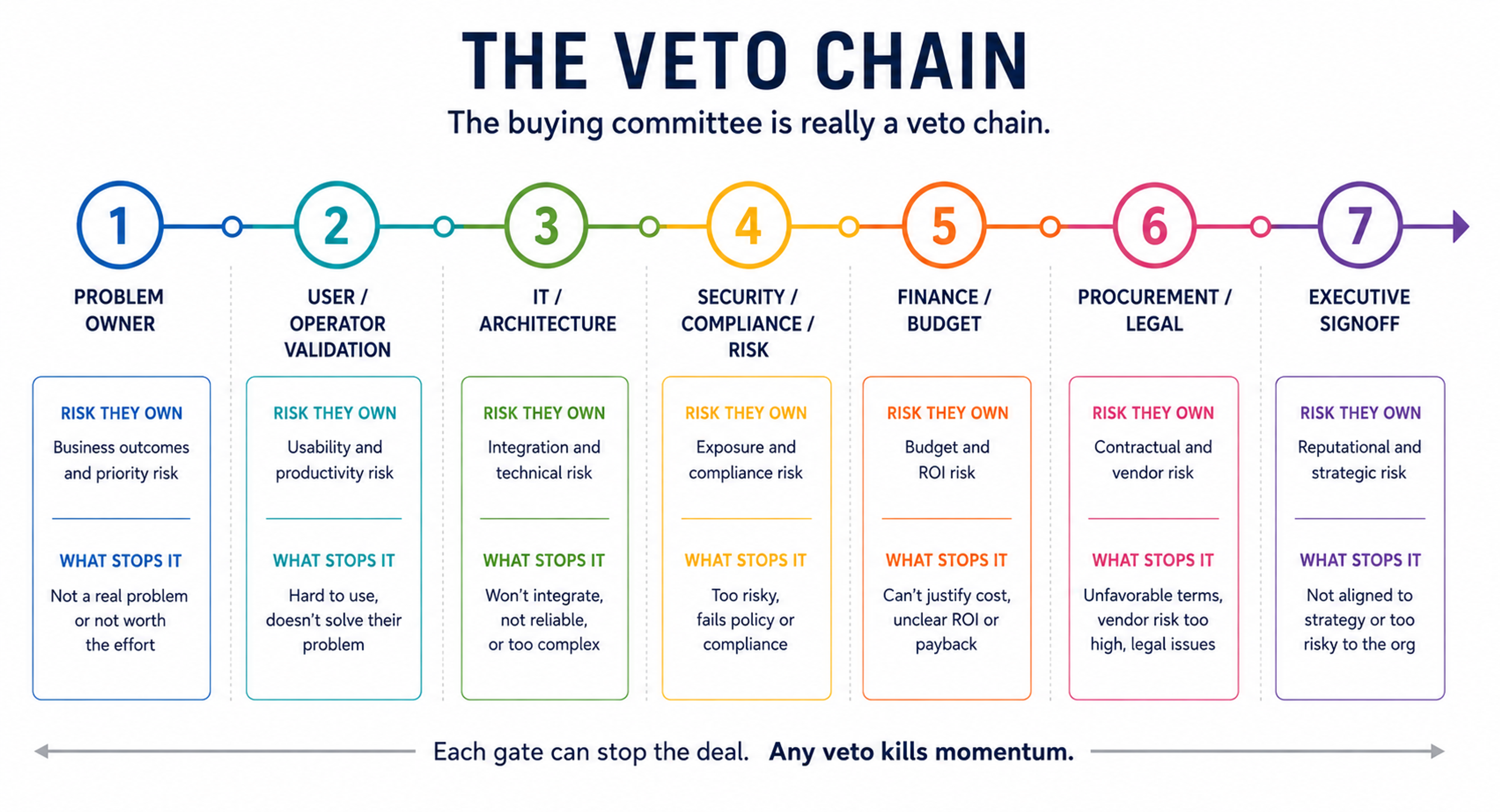
The chain as a model is important because the claim here isn't that these things happen in order, but rather these are all things that will come into play at some point as essential parts of closing the deal. You need to have something thoughtfully prepared around how you will respond to each, and if one of them is weak, the whole thing will break.
We don’t call it a veto chain because everyone formally votes. Most don’t. But plenty of people can block progress because they own a risk you haven’t figured out how to clear.
That explains more of what actually happens inside a deal. A purchase progresses until it reaches the person or function responsible for a kind of failure the previous group could not clear. If that risk owner is satisfied, the deal advances. If not, it stalls, morphs into something else, or is declared dead meat.
The Deal is a Route, Not a Room
Most sales language flattens this process. You’ve probably heard stuff like “we need to multi-thread the account,” as if connecting sales with more people will progress the deal if the sales team is likable to enough people.
That’s useful, of course, but it’s not enough. Knowing more people isn’t the same as knowing how a decision is routed and how to prepare for the sensibilities of those people.
The route matters because stakeholders don’t enter the deal at the same time. What we usually see in complex B2B deals looks something like this:
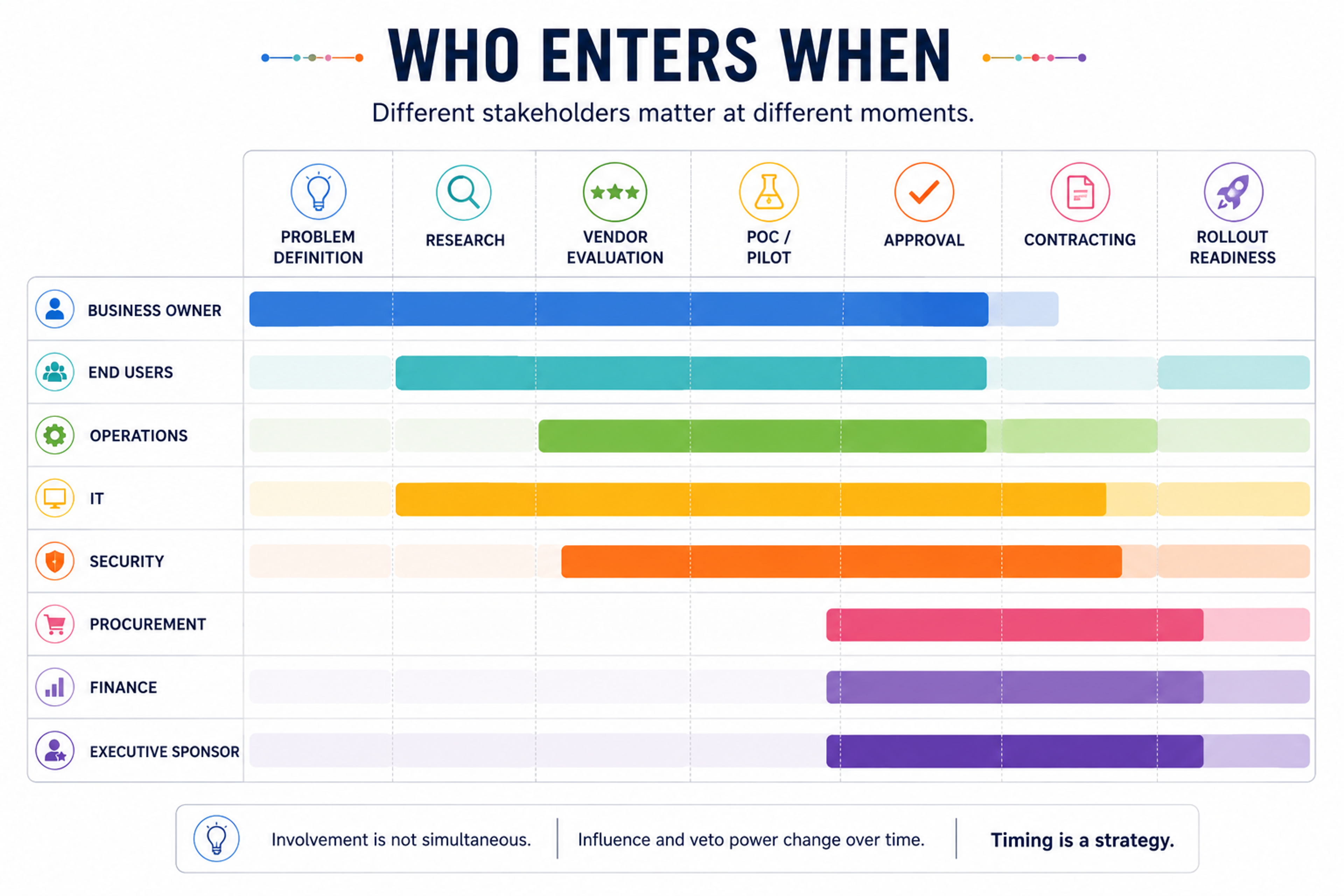
In many orgs, the first real hurdle isn’t vendor selection—it’s internal legitimacy. Someone has to get the problem recognized as worth solving before budget exists or any formal evaluation starts. Only after that does a more visible “process” begin.
That distinction changes things.
If the problem itself isn’t approved, no amount of product proof will rescue the deal. If the problem is approved but ownership is unclear, the deal will wobble. If ownership is clear but the spend crosses a threshold, new people appear. If the tool touches regulated data, new people appear again. If it affects multiple business units, the route gets longer and authority gets blurrier.
The conventional wisdom is that deal complexity is positively correlated with more stakeholders. That’s kind of true. But complexity in a large org actually creates more categories of risk, and each risk tends to have a human attached to it.
This is why a deal can feel healthy in one meeting and fragile in the next. The people in the room may like it, but the next unresolved risk may belong to someone who hasn’t entered the deal yet.
Consensus is Really Just Progressive Risk Clearance
From the outside, complex buying is often described as “consensus buying.” That is directionally right, but the mechanism is less about simultaneous consensus and more about sequential clearance.
- One group gets comfortable with the business case.
- Another checks technical fit.
- Another reviews security posture.
- Another looks at legal exposure.
- Another cares about procurement terms.
- Another signs off only because the amount crossed a threshold.
The process looks political because it is political. But it isn’t random. It follows the distribution of risk inside the organization.
That’s also why not every stakeholder matters in the same way. Some are genuine economic decision-makers. Some are evaluators. Some are advisors. Some are process administrators. Some don’t decide at all, but still control passage through a gate that has to be crossed.
Treating all of them as equal “buyers” muddies the picture, as does treating them all as voters.
A more accurate view: different people become relevant when the purchase exposes a risk they own.
Routing Obscurity aka The Disappearing Deal Trick
Deals usually don’t die in dramatic 12 Angry Men-esque meetings where everyone declares a winner and a loser. They disappear into routing obscurity.
Both your reps and whoever owns win/loss analysis at your company hate this.
It might be some variation of: “Someone is waiting for legal. Legal is waiting for revised language. Procurement is waiting for a vendor form. Security is waiting for architecture. Finance is waiting for the updated business case.”
Everyone still says the project is moving, but nobody can say exactly where it’s stuck.
This is one reason sellers consistently misread deal health. They think they’re managing persuasion, when the buyer is actually managing passage.
That’s a completely different challenge. You can’t solve the problem of passage with another demo.
In a complex purchase, visibility into the precise point of blockage is often poor even for insiders. From the seller side, it can be almost nonexistent unless someone inside truly understands the route.
Too Many Decision-makers Creates Drag
There’s a fairy tale that more stakeholders produce better decisions. This happens very rarely. Most of the time we’re just being polite and/or trying to cover our own asses by including the right people in a decision that could easily be made by one or two. You ever tried to build one of those overcomplicated RACI charts that falls apart after a few days?
Lots of concerns raised in a purchase are legitimate, and large organizations are right to care about implementation, compliance, cost control, and downstream risk.
But as more people enter the process, the purchase gains more approval surfaces. As approval surfaces increase, the organization creates more ways for uncertainty to convert into delay.
This isn’t because people are stupid or irrational. They’re accountable for different things, and generally we all want to keep our jobs because we’d rather work than starve.
Security is paid to worry about one category of failure. Legal worries about another. Finance has its lens. Procurement has another. Executive approvers probably care less about product detail than precedent, rollout burden, standardization, or financial exposure.
Each additional stakeholder introduces a new version of “what if?” Usually that is healthy. Sometimes it is theater. Most of the time it’s both.
Either way, the deal gets harder when more unresolved risks are still live.
The Visible Process Often Starts After the Real Process Has Already Begun
None of this is news to anyone who has worked a real deal. Of course procurement and legal show up after earlier decisions have already been made.
The useful distinction isn’t between “hidden” and “visible,” as if one is mysterious. It’s between the part of the process where the deal gets shaped and the part where the organization starts processing what has already been shaped.
That matters because sellers often overread formal milestones. A shortlist, RFP, or procurement step can look like the deal is advancing when sometimes it just means the company has moved into formal handling.
The real question is whether the internal framing is in your favor: whether the problem is well-owned, the solution category fits, the budget logic is credible, and the route through risk owners is navigable.
That’s why “we made the shortlist” is such a weak signal on its own. It tells you the deal is in process. It does not tell you the process is going your way.
The Process Owner is the True Hero
Someone has to manage this chain from the inside.
In effective buying motions, there is usually a real process owner: someone who does the stakeholder homework early and understands enough about the business case, process, implementation burden, and politics to carry the purchase through.
That’s a demanding role.
This person isn’t just a champion in the thin sales sense of the term. The common definition of a champion often feels like some variation of an internal fan. But that’s too weak.
A real champion is more of a process owner who is part translator, part project manager, and part political operator.
They know which concerns are real and which are theater. They know whether security must review before architecture or after. They know which executive only cares if the amount crosses a threshold. They know whether legal will object to standard terms, whether procurement can negotiate this quarter, and when to involve finance. They know the difference between enthusiasm and authority.
Most crucially, they do stakeholder homework early.
Good process owners don’t wait until a contract is in redlines to discover that two adjacent teams disagree on ownership. They don’t wait until final approval to find out the spend exceeds someone’s signing authority. They don’t assume user excitement will overpower compliance concerns.
Champions and end users matter, but they don’t replace signoff authority, compliance review, or cross-functional feasibility checks.
If you want one sentence from this chapter to travel into boardrooms and pipeline reviews, make it this:
Deals don’t move through organizations because they’re wanted. They move because someone knows how to route them.
Thresholds Create New Approvers
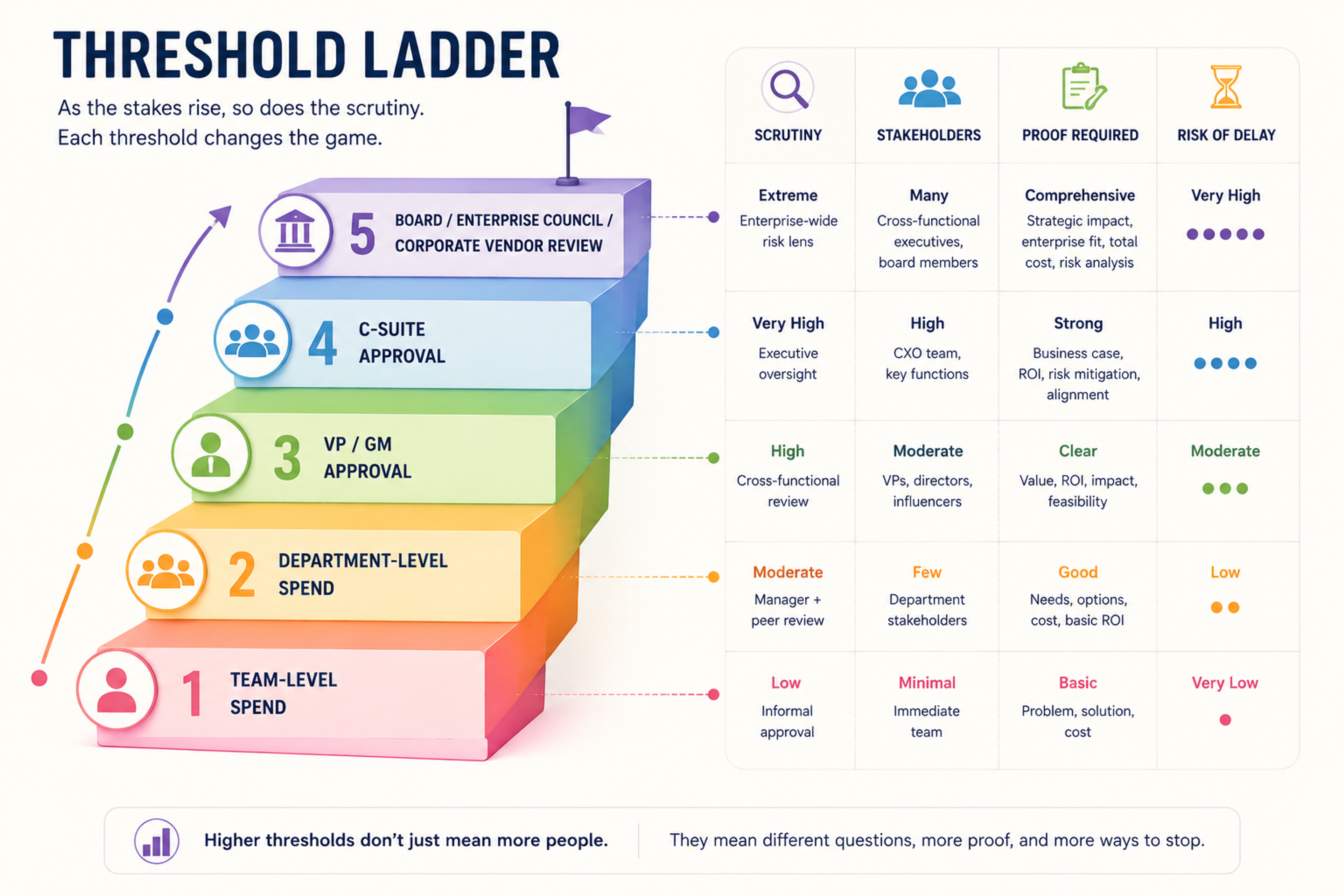
One reason the buying committee metaphor fails is that it ignores thresholds. In real companies, who matters changes when the number changes.
A manageable departmental purchase may live with the requesting team, finance, IT, and procurement. Increase the amount and suddenly leadership appears. Increase it again and the COO, CEO, or even board-level oversight can enter.
Larger purchases trigger additional scrutiny because the organization treats them as different categories of risk.
That means a deal can mutate midstream.
A team may evaluate a tool as a local workflow decision, only to discover that the budget level transforms it into an executive decision. At that point, the criteria change. The executive approver may care less about product detail and more about standardization, rollout burden, precedent, or financial exposure.
The team thinks it’s buying software while leadership thinks it’s approving a pattern.
That is why some deals get more difficult as they get larger. Not simply because the dollars increase, but because the purchase gets reclassified socially inside the organization.
Cross-functional Value Often Makes Buying Harder, Not Easier
Vendors love to say a product helps multiple teams. But shared value does not automatically make a purchase easier to approve.
Usually it does the opposite.
If one business unit can own a tool cleanly, the route is shorter. If the tool affects multiple business units, routing gets more complex and authority becomes harder to pin down.
Shared value creates shared governance. Shared governance creates ambiguity. Ambiguity creates delay.
That pattern becomes even more pronounced across regions, regulated environments, or governance-heavy categories. The moment a purchase touches model risk, data residency, regulated workflows, AI governance, regional rules, or multi-jurisdiction compliance, specialized stakeholders appear because specialized consequences appear.
This is usually interpreted as annoying, pointless bureaucracy. I like to think of it as an organization distributing responsibility for different kinds of failure. Remember how most people would rather work than starve?
What looks messy from the outside often makes perfect sense from the inside.
Why the Process Feels More Complex Than the Org Chart Suggests
A standard org chart implies stable boxes and clean reporting lines. Buying doesn’t work that way.
Risk ownership cuts across functions. Financial authority follows thresholds. Operational ownership may sit with one team while implementation burden lands on another. The person who wants the tool may have the weakest formal authority in the entire process.
That is why complex buying can feel so confusing to sellers. They are looking for the decider, while the organization is looking for legitimate custody of risk. Two very different things.
Once you see that, the apparent complexity becomes easier to interpret. The route isn’t long because everyone wants to be involved. It’s long because different parts of the organization are being asked to accept different kinds of exposure.
A veto chain is simply what distributed risk looks like in motion.
From Committee Thinking to Route Thinking
So what should a senior GTM leader take from all this?
First, stop imagining the deal as a room. Imagine it as a route.
A room implies simultaneity, shared context, and collective resolution. A route implies sequence, handoff, and the constant possibility that the next person is solving for a different problem than the last.
Second, distinguish observed complexity from explanatory complexity.
The observed fact is multiple stakeholders. The explanation is not “modern buying is collaborative.” Organizations assign different risks to different functions and thresholds. That’s why the process feels fragmented—and why persuasion or great differentiation alone is never enough.
Third, avoid stakeholder count as a proxy for deal health.
More contacts may mean better coverage, but it could just as easily mean the decision has entered a more dangerous part of the route. What matters is whether you understand which risk each person owns, when they enter, and what could make them block progress.
Fourth, take internal process ownership seriously.
The clearest buyers don’t want more charisma from vendors. Your sellers need a credible operator on the buyer side who supports the stakeholder homework, shapes the sequence, and moves the deal through the chain.
The old language of “selling to the committee” is too flat for this. It misses the timing, asymmetry, thresholds, and veto power. It treats every stakeholder as a voter when many are really gatekeepers.
And gatekeepers only need to feel unresolved risk to kill your win.
That’s why the buying committee is really a veto chain. Or, if you prefer the friendlier version, a relay of risk owners. Either way, the mechanism is the same. One group can only pass the purchase forward once it’s reduced enough uncertainty for the next group to take custody.
Once you can see that route, the next question becomes much more interesting.
If these stakeholders are not simply “involved,” but each interpret evidence through the lens of the risk they own, what are they actually evaluating? Why does one demo reassure legal but unsettle security? Why does the same reference call calm a business sponsor yet do nothing for procurement? Why does a product advantage sometimes create more anxiety rather than more confidence?
That’s the next layer. Once the stakeholder route is visible, the real question is what those people believe they are seeing—and why, in complex B2B buying, the safest believable story so often wins.