Part one of a five-week series on modern GTM storytelling. A new chapter drops each week.
Early in my career, right after graduate school, I got a lesson in B2B decision-making that turned out to be more useful than anything I learned in class.
I was working at a successful SaaS company when I was asked to help save a large account that was preparing to churn. The Chief Product Officer was sponsoring the effort, and he asked me to come back with a list of every reason the customer was leaving.
So I did what a lot of smart people at SaaS companies do when they hear a question like that. I went straight to the product.
My team pulled together everything we had: feature requests, missing functionality, roadmap gaps, recurring complaints, bugs, adoption friction, all of it. Then we sat down with the CPO to review the list.
The exchange was short.
I said, “Here are the reasons.”
He said, “No. These are the things they don’t like about the product. That’s not the same thing as why they’re churning.”
At the time, that sounded like semantics, but it wasn’t. He was forcing a distinction I hadn’t learned to make yet: the difference between a product complaint and a decision driver.
When we went back and did the work the right way, we found something much more interesting. The account wasn’t leaving because the product lacked some single critical capability. They were leaving because the people who’d seen value from it weren’t the people shaping the renewal decision. The useful stories were scattered across support threads, isolated wins, and moments of real impact that had never been organized or brought in front of the executive who actually had to approve the renewal.
The champion understood the value, but the person who needed evidence supporting the value to make the decision didn’t.
This is a familiar scenario to anyone who has worked in customer success.
So instead of building a roadmap defense, we rebuilt the story. We went back to the original reason they’d bought, gathered specific examples where the product had helped, and turned them into a simple recap aimed at one audience: the executive deciding whether to renew.
It wasn’t a boring deck about what the platform might do someday. We put together a set of collateral showing what it had already done, where it had helped, and why that mattered to the business.
We gave it to the internal champion and let them carry that story into the conversation themselves. Eventually, the account renewed.
They didn't renew because the roadmap changed or because every complaint disappeared. They renewed because the right story finally reached the right person in a form they could use.
That lesson has stayed with me ever since. In B2B, the thing a customer complains about isn’t always the thing that decides the deal.
And that’s not just a retention lesson. It shows up in new-logo sales constantly.
As a fan of both mushrooms and the Titanic, I’ll spare you the overused iceberg model and instead visualize this using what feels more appropriate: a mushroom (in this case, amanita muscaria) springing from a vast, ancient, and unseen mycelial network:
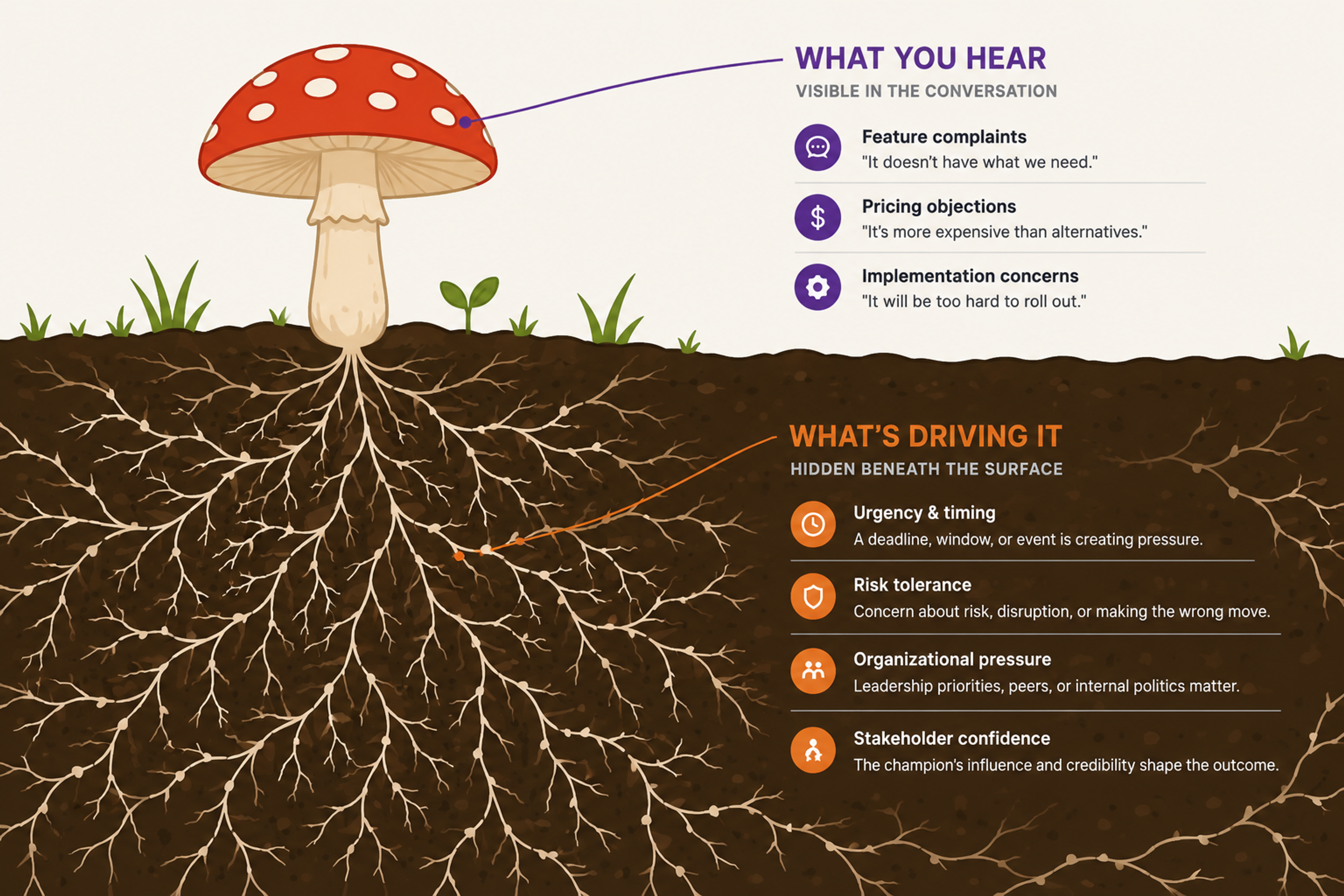
Human social connections (and most things people try to model with icebergs) have a lot more in common with mushrooms than icebergs, but that's a topic for another day.
The Same Product Can Win on Tuesday and Lose on Thursday
If you’re in a larger B2B company and have a decent win/loss program with good insights, you’ve probably seen some version of this already.
One rep wins a deal selling the same product, at roughly the same price, against the same competitor. Two weeks later, another rep loses what looks, on paper, like an almost identical opportunity.
It could be the same category, market, use case, competitive set, and probably the same pitch decks and collateral.
Then everyone gathers for the deal review and asks: "what did the losing rep do differently?"
Sometimes the answer is tactical, but often the more important difference was already present inside the account before the first call happened.
One buying group was under pressure to move fast, while another was under pressure to avoid risk. One had an internal sponsor with credibility. Another had a sponsor who could get meetings but not agreement. One deal had a visible initiative attached to it. Another had to survive legal review, security review, budget scrutiny, and a leadership change all at once.
The product you’re selling may have been the same. The decision environment for the prospect wasn’t.
That’s the operating reality GTM teams have to contend with in bigger B2B companies. Your challenge isn’t just to create a compelling message, but to also help the company operationalize the right story across a complex, shifting buying group, consistently enough that outcomes depend a little less on intuition and a little more on shared understanding.
That’s a very different job than writing good positioning and messaging.
Buyers Evaluate Features, but They Decide Based On Equally Important Reasons.
Buyers absolutely evaluate features and compare capabilities. They ask for demos, security documentation, implementation details, customer references, contract terms, and proof. The product matters. Functionality matters. In some deals, a missing capability really is the reason the deal stalls.
But product evaluation doesn’t usually explain the whole outcome on its own.
What actually moves a purchase is often a reason sitting underneath the evaluation.
Sometimes that reason is functional: faster implementation, better governance, less manual work, a cleaner workflow, or more confidence in adoption.
Sometimes it’s organizational: a quarter-end initiative, a failed prior rollout, executive visibility, budget timing, a reorg, or a team that can’t afford one more messy implementation.
Sometimes it’s political (in the least dramatic but most realistic sense of the word). Someone needs this decision to feel safe or defensible, or they're trying to avoid introducing risk, or trying to show momentum. It could be as simple as someone wanting a vendor they can trust not to make them look stupid in front of leadership.
Those reasons often matter just as much as the feature comparison, and in many deals they matter more.
This is why companies can obsess over feature matrices and still struggle to explain why similar deals end differently. A feature matrix can tell you what buyers compared, but can’t always tell you what they were trying to protect, prove, avoid, or accelerate when they made the decision.
Ignoring this step is exactly why every tech company still thinks bolting the word "AI" onto everything on their homepage is the secret to improving win rates. It's actually the tone-deaf opposite of building stories specific to your buyer's circumstance.
Messaging Hint: outside of investors and board members telling your C-suite what to do, nobody cares if something is "AI-powered".
If your company only operationalizes what the product does, but not why it matters in the context of a live buying decision, the most important parts of the story stay trapped in your orgs tribal knowledge. One rep senses it, while a manager remembers it, while the PMM hears it in an interview. Meanwhile, execution stays inconsistent.
The Buying Group Isn’t Fixed, but the Pressures Are.
One reason simple buyer models break down in larger B2B sales is that the buying group never behaves like a tidy chart. These suggestions are based in models, and those models are as much of a reflection of reality as a matchbox model car is to a full-sized car.
There’s usually a business owner. Often a user or operator, budget approver, technical reviewer, procurement, legal, security, or compliance. Sometimes an executive sponsor. Sometimes a skeptical stakeholder with enough influence to slow everything down. Sometimes one person carries several of those concerns.
The point isn’t to count them, but rather to understand the pressures they bring into the decision.
In most complex B2B purchases, some combination of the following always shows up:
Business outcome pressure. Will this solve a meaningful problem or help an important initiative move?
Adoption pressure. Will the people expected to use it actually use it?
Technical fit pressure. Will this work in the existing environment without creating a mess?
Risk and governance pressure. Will this introduce security, legal, compliance, or operational exposure?
Financial pressure. Is the spend justified, and will the value hold up under scrutiny?
Internal credibility pressure. Will the people backing this decision look responsible and well-prepared, or exposed and reckless?
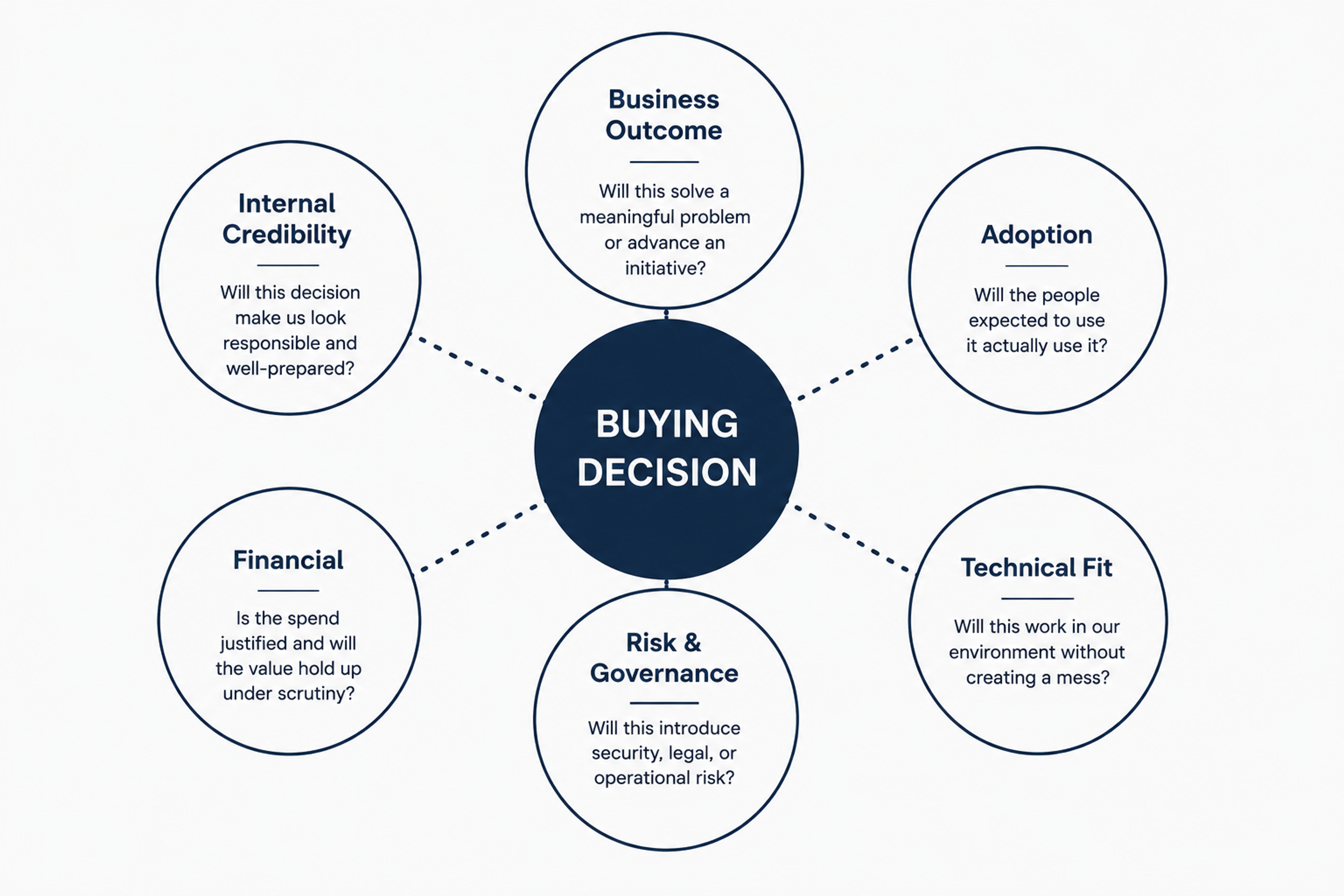
It's more useful to think in terms of a collection of decision pressures rather than personas that might care about one of these in isolation. In one account, one VP may carry half of them. In another, they may be split across operations, IT, finance, procurement, security, and a business-unit lead. In one quarter, budget pressure dominates. In another, a recent failed implementation makes risk the louder force.
The group and motivations shift. Thus, the story has to shift with them.
Personas Help but Still Fall Short
It would be easy to overcorrect and say personas are useless. They’re not.
Personas are wrong in that they describe imaginary people, but they also capture useful patterns. They help teams understand the outcomes a role tends to care about, the risks that role tends to notice, the language that feels credible, and the objections that come up repeatedly.
The problem is asking persona work to do too much.
A persona can tell you what a head of operations probably optimizes for. It can’t tell you that this particular head of operations is recovering from a failed systems rollout and now cares more about smooth implementation than long-term flexibility.
A persona can tell you what a finance leader usually asks, but it can’t tell you that this quarter they’re under extra scrutiny because budget froze, reopened, and then got tied to a board-level initiative.
That’s why persona-driven messaging often feels both directionally right and commercially incomplete.
It answers who in a general sense. It often misses the context around what’s true now and why it matters.
The better move isn’t to throw away personas, but to put them in the right place. They’re one layer of the system, not the whole system.
Personas tell you what’s often true while context tells you what’s true now. The relevant buyer story happens at the intersection.
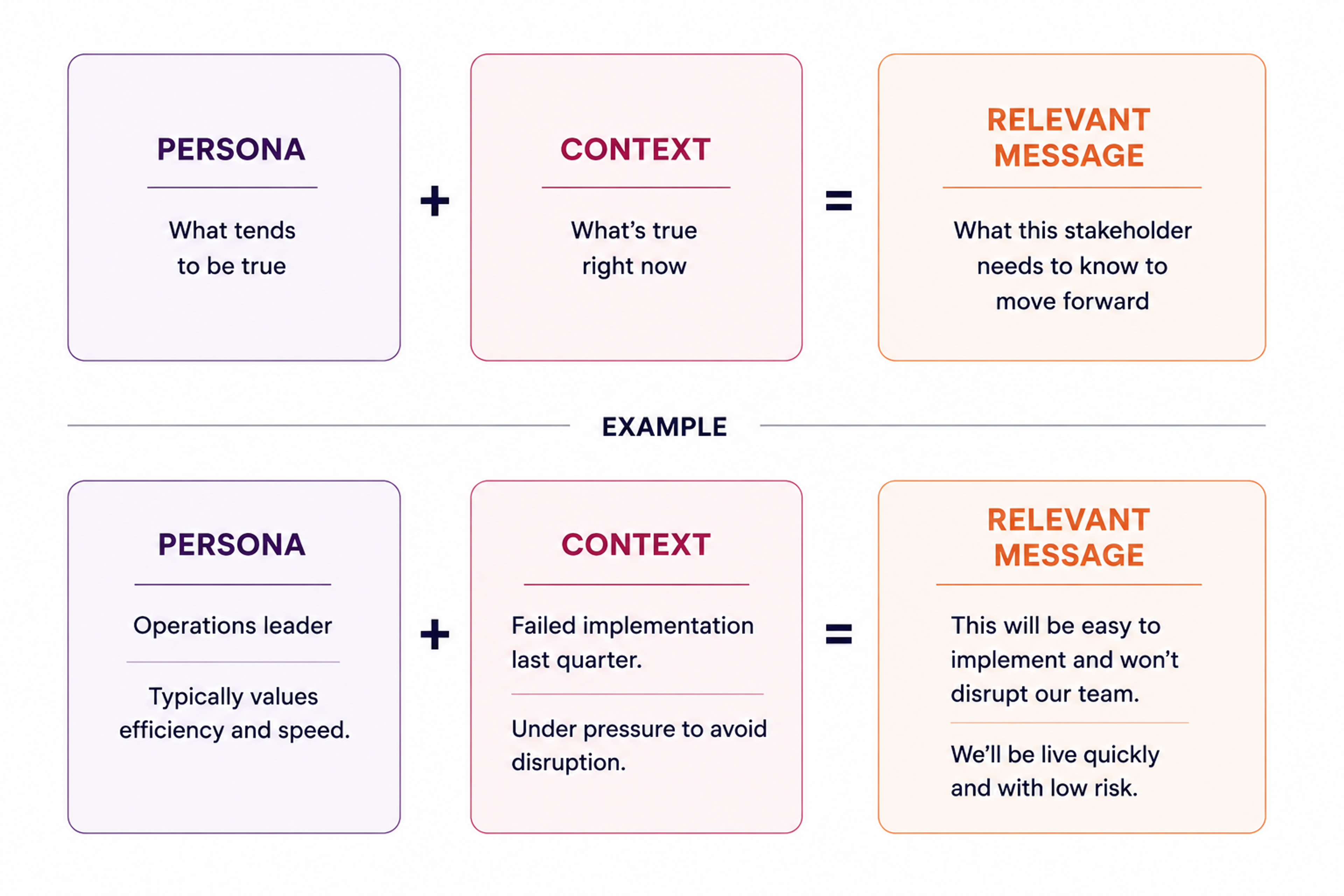
Same Buyer, Different Quarter, Different Story
Even when the stakeholder list looks familiar, the story that works can change quickly.
The operations leader who wanted speed last quarter may want control this quarter. The executive sponsor who pushed for innovation six months ago may now want a safer vendor after another project went sideways. The team that once cared most about flexibility may suddenly care more about standardization.
This is where a lot of internal message coordination breaks down.
Marketing keeps using the category story. Product keeps talking about capability. Sales keeps using last quarter’s deck. Enablement keeps training to the median case. Leadership keeps asking why conversion didn’t improve.
Meanwhile, the actual deal is being shaped by conditions that sit outside the formal messaging hierarchy altogether.
Messaging still matters, but it has to be more operationally connected to buyer context than most companies make it.
The challenge for larger B2B organizations isn’t just creating one strong narrative, but making that narrative adaptable enough to serve multiple stakeholder pressures without dissolving into a hundred disconnected versions of the truth.
Product Value Still Needs to Be Translated
Like I mentioned earlier, sometimes the product really is the key reason for the win.
But even when product value is the core of the decision, it still has to be translated across the buying group.
Take something as basic as single sign-on.
The weak version of the message is simple:
"Single sign-on gives users one login across the platform."
That’s accurate, but it’s also incomplete.
The more useful question is: what does single sign-on change for the specific stakeholders involved in this decision?
For one stakeholder, it means fewer help desk tickets and less user friction. For another, easier onboarding and smoother adoption. For someone in security or IT, it means fewer identity-management concerns and one less reason to escalate review. For an executive sponsor, it may mean the purchase feels more mature, more governable, and less likely to create embarrassment later. For the internal owner trying to get the deal through, it means one more part of the recommendation feels safe to repeat internally.
The capability is the same. The consequence is different depending on who has to believe in it.
That doesn’t mean inventing different stories for different people. It means expressing the same truth through different lenses of relevance.
Teams lose trust when messaging changes the truth to suit the audience. They gain trust when messaging preserves the truth while making its implications clearer for the stakeholder in front of them.
For Product Marketing and GTM teams, this is where the work becomes operational. The question isn’t whether you can describe the product, but whether you can equip the field to translate real capabilities into stakeholder-specific confidence under pressure and at scale.
Most Teams Have Insight Without a System.
That’s the real problem hiding underneath a lot of messy deal execution.
In most larger B2B companies, useful buyer insight exists somewhere. Sales hears it in calls, or customer success hears it during renewals. PMMs hear it all over the place, and executives hear it in escalations. Enablement hears it in coaching.
But those insights rarely become a coordinated system before the next deal starts moving. Instead, they live as fragments.
A rep remembers that security slowed the last three deals. A PMM knows a certain message resonates with champions but not with finance. A sales leader knows legal gets nervous when the business case is fuzzy. An enablement partner knows the deck is too product-heavy for late-stage conversations. A GTM strategy lead knows that wins cluster when there’s a visible initiative attached.
All of that may be true, and still the company behaves as if the message is settled because the slide deck exists.
This is where bigger companies start paying a real tax on tribal knowledge. The insight is there, but it’s trapped in people rather than operationalized into the story, assets, training, deal guidance, and handoffs.
That’s why this chapter (and how we eventually approach the solution) isn’t really about understanding buyer psychology as much as it is about reducing randomness
If you’re in PMM, your challenge is to turn buyer nuance into messaging backed by real insight that's usable across teams.
If you’re in Sales Enablement, your challenge is to make sure the field can recognize active stakeholder pressures and adjust the conversation without abandoning the core narrative.
If you’re in GTM Strategy, your challenge is to build a more repeatable operating model so outcomes rely less on heroics and more on shared patterns.
That work requires speed, but not guesswork. It requires nuance, but not chaos.
A Better Framework: Who, When, and Why
This is the framework that matters most for the rest of the book.
Most teams are reasonably good at the first question and inconsistent on the other two.
Who is involved in this decision? Not just job titles, but what pressures sit with which stakeholders. Who’s trying to drive the initiative? Who has to approve the spend? Who can slow the process? Who has to live with the implementation? Who’s carrying reputational risk?
When is this decision happening? Not in your quarter, but in theirs. Are they in planning season? Mid-reorg? Cleaning up after a failed vendor choice? Under pressure to show movement before an executive review? Trying to avoid disruption before a major launch?
Why does this decision matter right now? What’s the actual reason this purchase is active? Is it tied to a strategic initiative, an acute pain point, a budget deadline, a compliance concern, a leadership mandate, a team bottleneck, or a need for a low-drama decision that can survive internal scrutiny?
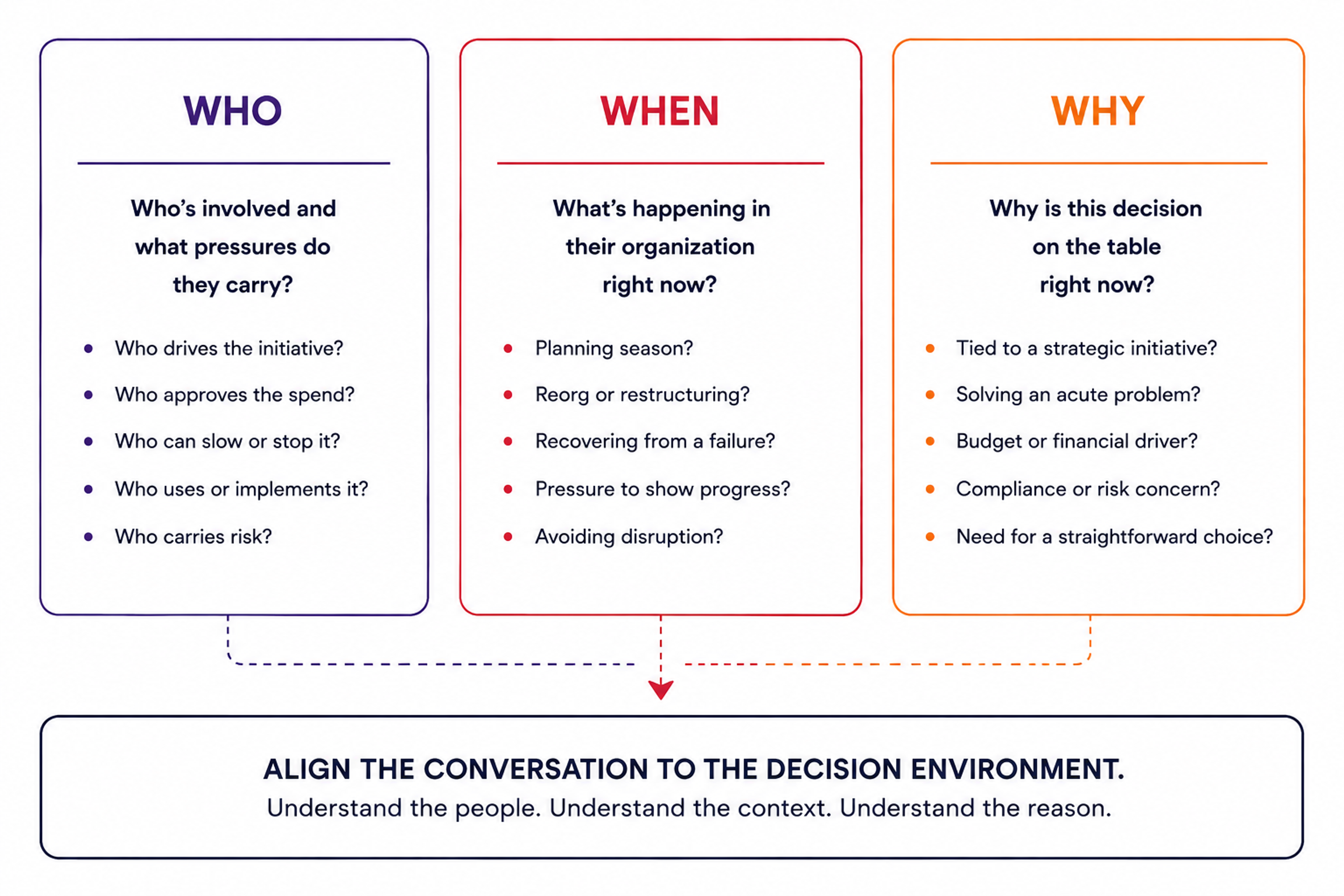
Who, when, and why is elementary stuff. In practice, it’s the difference between generic messaging and relevant execution.
It helps PMMs build narratives that don’t stop at persona assumptions. It helps enablement teams train for real decision environments, not idealized sales stages. It helps GTM teams spot patterns that can be scaled instead of rediscovered one deal at a time.
Most importantly, it creates a shared language across functions. Not just about who the buyer is, but about what the organization needs to understand in order to help that buyer move.
The Work of Strategic Message Operations
The strongest go-to-market teams don’t just produce messaging. They go a step further and operationalize message coordination.
They make sure buyer-backed insight doesn’t stay buried in research readouts, call recordings, postmortems, or the heads of experienced reps. They build ways for the company to test, refine, and distribute the story so sales, product, marketing, and leadership are working from the same set of buyer realities.
That sounds obvious, but it isn’t common. You probably want to do this more than you’re actually doing it.
In many companies, message changes are still driven by opinion, seniority, or whatever theme is loudest in the market that month. Teams rush to update language before they’ve validated whether it actually resonates. They create new decks faster than they create new understanding.
The better model is slower in one sense and faster in another.
Slower to make unsupported claims. Faster to turn real buyer insight into action. Faster to give teams a shared source of truth. Faster to update stakeholder-specific language when the market shifts. Faster to align sales, marketing, and product around what buyers actually care about.
That’s what reducing randomness looks like in practice.
There's no perfect pitch, persona, or battle card that magically fixes execution.
But instead there's a repeatable system for understanding the decision environment, validating the message, and helping the field carry the right story across a shifting buying group.
The Point of This Book
Up to this point, we’ve discussed theory. The rest of this book is about making that system practical.
How do you identify the decision pressures active in a deal without collapsing into anecdote? How do you separate durable buyer patterns from temporary situational factors? How do you turn real buyer insight into messaging that sales can actually use? How do you coordinate the story across PMM, enablement, leadership, and the field without creating more noise?
Those are operational questions as much as messaging questions.
And they matter because most lost deals don’t come with a clean explanation. By the time a company realizes the signer never heard the right business case, the security concern surfaced too late, or the champion was repeating a weak version of the story, the deal is already gone and everyone’s reconstructing the truth from crude notes.
You can build a system that gives your teams faster access to real buyer insight, a clearer understanding of stakeholder-specific concerns, and a more consistent way to translate that insight into action across the company.
That starts with a simple but uncomfortable recognition.
Your product may be good, your deck polished, your category story sharp, and you can still lose if the buying group never gets the version of the story they need in order to say yes with confidence.
It's not a failure of persuasion alone as much as a failure of operationalizing the right message across the real complexity of B2B buying.
The product marketers and GTM teams that improve win rates, shorten ramp time, and create more consistent execution aren’t usually the ones with the fanciest messaging framework. They’re the ones that get better at turning buyer reality into repeatable field behavior.
That’s the work.
And it begins by admitting that product truth and deal truth are related, but they’re not always the same thing.
Chapter 1: TL;DR
- Buyers evaluate features, but they usually decide for reasons that sit inside a broader decision environment.
- In complex B2B sales, those reasons are distributed across a shifting buying group carrying different pressures around outcomes, adoption, technical fit, risk, financial scrutiny, and internal credibility.
- Personas remain useful, but they’re incomplete without context. Even when product value is central, it has to be translated differently across stakeholders.
- The next chapter starts building that system with a closer look at how to identify what buyers actually need to believe before a deal can move.