On a day in mid-June, I was a few weeks into my new role at GetWhys and also on a FaceTime call with my mother.
Stick with me. It’s all related.
My very non-technical, excited-when-she-learned-to-attach-photos-to-emails mother was standing in the middle of what she calls the “compost garden” – the space where crops grow when seeds from her compost get out of control. Some of the best tomatoes I’ve ever had come out of the scraps of food they churn into this soil.
During this conversation, I made the mistake of using the term “dogfooding” while trying to describe our upcoming launch.
I’ve always had trouble describing my role in the world of tech to family members and non-tech friends. We forget that sentences like, “you just have to set up GetWhys MCP in Claude for your team if you want to reduce their tool fatigue while still checking the content they generate against a proprietary buyer intelligence database” mean jack squat to some folks.
That is to say, a sentence like this would send my mother running.
Unfortunately, I did say something along those lines, and I’ve been thinking back on that conversation ever since, as I continue try to describe our recent product launch to friends and family. Because what I should have said was, “let me think about the best way to describe it and get back to you.”
This is me coming back to describe a few of the ways we dogfooded our own product to run a successful product launch, in gardening terms.

We used GetWhys to validate our content against what our buyers said they needed
As with every team launching a new product, we wanted to write about GetWhys in ways that showed we understood the pain points of our potential buyers. Lucky for us, GetWhys validates content against real buyer interviews, ones that surface their actual needs (not just the ones we think they have, but ones they’ve said they have because, gasp, we’re guilty of thinking we know it all too, sometimes). Yes, GetWhys employees submit their own research requests to better understand the market – we’ve literally built a database and a tool that continuously checks whether or not we’re positioning ourselves well in the market, even as our ICP and user personas shift and we explore uncharted waters. It’s the dream.
So obviously, we use the ability to validate our positioning on ourselves.
Here are just a few places we used GetWhys to write & check our own launch content:
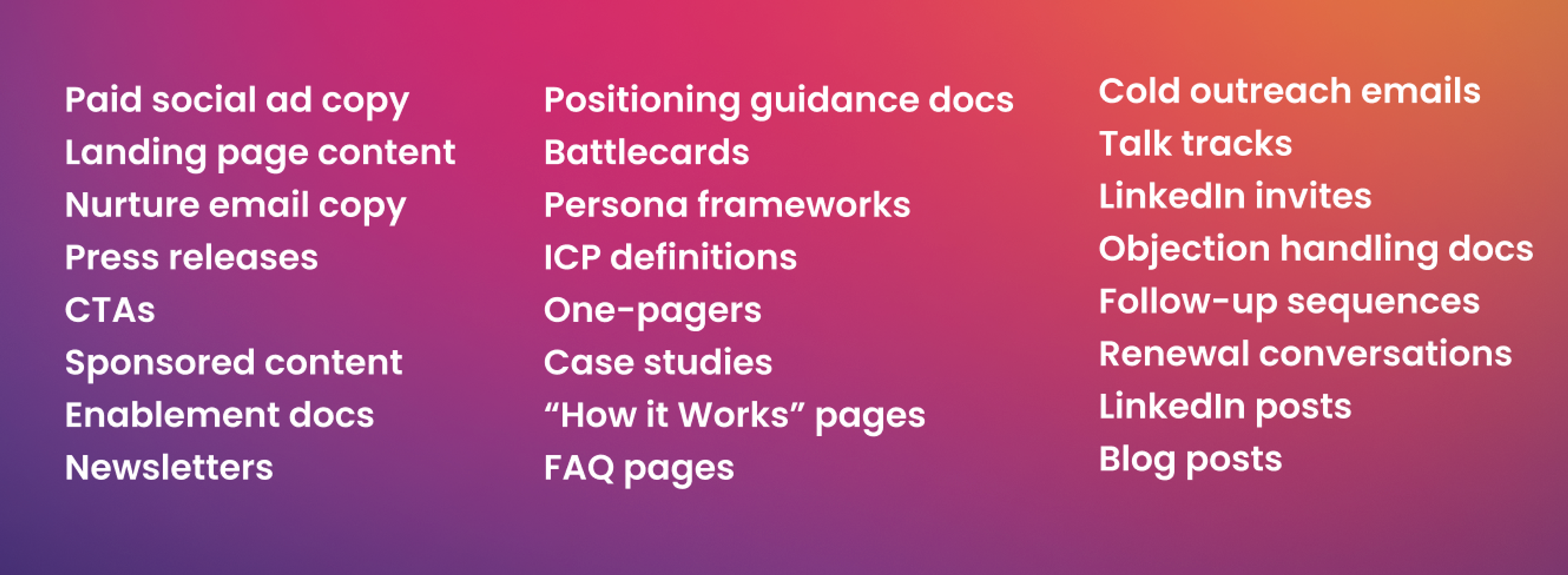
In gardening terms: instead of planting an entire garden, waiting for everything to grow, then measuring how many bees the flowers we chose to plant attracted, we…asked the bees which flowers have the best nectar to bring them in, and why. If I were appealing to the dads out there, I’d say, “we determined which flowers would generate the most…buzz…before we picked out the varieties.”
We submitted GetWhys research requests to determine the problems our buyers were facing
Research requests are baked into the culture here at GetWhys – we’re not afraid of making a request, and there is a warm, fuzzy layer of comfort knowing that if we don’t have the answer to a question about our current or future buyers, we have a ridiculously good research team that can get us answers in an unbelievably quick amount of time.
Think about requesting traditional buyer research to back up a hypothesis you’ve been noodling on for a while, research that includes citations and buyer quotes – the kind of research your boss requires you to have before you test out any fun ideas. I’m willing to bet you’d rather not.
For us, it’s second nature. Our research database has the kind of depth that inspires confidence we can get the answer we’re looking for, and the research team behind it has the genius to get us the answers we need whenever we expand into uncharted buyer territory. And we used it. That research and those buyer answers brought you the product we highlighted in our launch: one that works where you work via MCP. One that lets you and your stakeholders enter with a rough draft and leave with a buyer-backed final copy. One that allows you bring your work to your boss and say, “look, my work in GetWhys improved X pieces of content, lifted content scores by Y amount, and showed us that Z frameworks drove the most GTM impact.”
So yes, we talk about our “proprietary database of thousands of research interviews, with unlimited research requests” a lot. It’s a mouthful worth saying over and over because we love and use the heck out of that feature.
In gardening terms: ****the Farmer’s Almanac has a lot of helpful research that guides gardeners on how best to plan for their garden based on hard research and anecdotal evidence, but sometimes an unexpected shift in conditions or the need to change plans means you require extra info. Unlimited research requests are like having scientists on call when you find yourself needing new answers, ones that aren’t restricted by funding availability or red tape.
We had lively brainstorming threads on Slack and asked GetWhys to check us on our ideas
The inner workings of a company Slack instance in the weeks before a product launch are kept behind closed doors for a reason. Between jokes about funny ways to generate interest and questions about how best to describe this hard-to-conceptualize feature, it’s easy to discount Slack as a place where ideas go to die. Instead, we called in the GetWhys Slackbot…to see if those ideas had traction. And you know what? Many of them got refined, and stuck. “GTM or GTFO” jokes made it onto hats we sent out. One-liners were used in LinkedIn announcements. All because we didn’t let those ideas slide and made sure they’d resonate. And they did.
In gardening terms: ****you attend the garden party of a friend. You’ve all had one too many glasses of rosé and everyone is shouting out ideas on how to get more nutrient-dense soil at volumes three levels louder than conversationally necessary. There is a designated driver in attendance. One who knows gardening and has the good sense to say, “Please don’t do that,” or, “That’s a terrible idea,” or, “That is absurd but…I kind of think it could work.”
The garden party is the product launch. The designated driver is the GetWhys Slackbot.
In the end, maybe my best bet would have been going the metaphor route to explain dogfooding:
“You know how the scrapped bits of veggies you’ve already grown get used in the compost garden, only to grow better and better produce from what pops up naturally, or from the soil you get from this practice? Well we…we grow our own product, then we use our own product to make that product better and to market the product. It’s like doubling down on the idea that what you create yourself is better than anything you can get from the store, and comes with more pride than just buying something you have no control over or stake in.”
Instead, I ended up with a confused mother and this blog post.
Feel free to send this post to your gardening friends and family if you want to explain what you do in GetWhys (don’t worry, I’ve already sent it to my mother). And if you don’t use GetWhys yet, what are you doing? I’d insert a sneaky, veiled line trying to get you to book a demo, but GetWhys told me our buyers appreciate a more direct approach.
We’re here to get you a demo tailored to your use case whenever you’re ready.